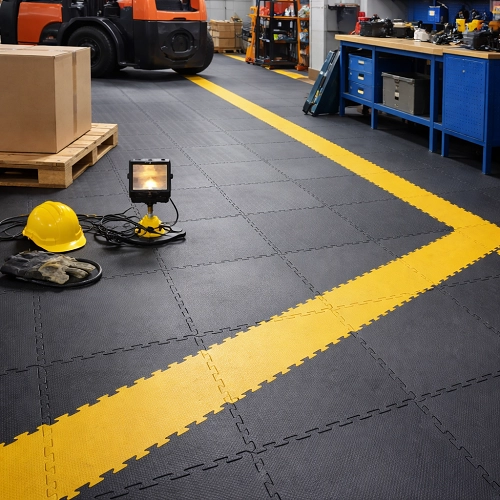
PVC industrial tiles have become a go-to flooring solution in many commercial and industrial environments due to their durability, ease of maintenance, safety properties, and cost-effectiveness.
What Are PVC Industrial Tiles?
PVC industrial tiles are modular flooring units made primarily from polyvinyl chloride (PVC), a thermoplastic polymer engineered to provide resilience, abrasion resistance, and chemical stability.
They are typically installed in commercial and industrial settings such as:
- Manufacturing plants
- Warehouses and logistics hubs
- Workshops and garages
- Laboratories
- Retail environments
- Healthcare and educational facilities
PVC tiles may be solid or composite (e.g., PVC with mineral fillers) and are often designed for interlocking installation, though some are bonded with adhesive where appropriate.
Key Technical Components and Materials
1. PVC Polymer Matrix
The core material is polyvinyl chloride, chosen for:
- Excellent resistance to impact and abrasion
- Inherent flame retardancy
- Chemical and stain resistance
- Long service life under heavy traffic
PVC itself may be modified with plasticizers, stabilizers, UV inhibitors, and fillers to tailor performance.
2. Fillers and Reinforcements
To enhance mechanical properties, tiles often contain:
Calcium carbonate or other mineral fillers to increase stiffness and reduce cost
Fiber reinforcements (glass or synthetic fibers) in heavy-duty tiles for tensile strength
The filler content influences density, hardness, and thermal stability.
3. Wear Layer
Many industrial PVC tiles feature a wear layer — a harder surface film that resists abrasion and wear. Typical thickness ranges from 0.5 mm to 2.0 mm, with thicker layers preferred in high-traffic zones.
4. Backing and Cushion Layers
Some tiles include a cushioned backing, enhancing comfort underfoot and improving impact-noise absorption. Backings may be closed-cell foam, anti-fatigue material, or plain PVC formulations.
Performance Characteristics
Mechanical Properties
- Hardness and Load Bearing: Defined by Shore hardness and compressive strength. High values imply better resistance to deformation under forklifts or pallet jacks.
- Impact Resistance: Ability to withstand falling objects or repetitive mechanical stresses.
- Slip Resistance: Textured surfaces or additives improve coefficient of friction (COF), critical for safety.
Environmental and Chemical Resistance
PVC industrial tiles exhibit:
- Chemical resistance to oils, greases, solvents, and many acids/alkalis
- Moisture resistance, preventing rot or delamination in wet environments
Chemical resistance varies by formulation and should be matched to site conditions.
Thermal Performance
PVC has a limited service temperature range (generally -10 °C to 60 °C). Extreme heat may soften the material, while very low temperatures increase brittleness.
Fire Performance
PVC naturally contains chlorine, which provides intrinsic flame retardancy. Many tiles are tested to fire performance standards and emit lower smoke and toxic gases than some alternatives, but testing and compliance are essential.
Standards and Testing
Performance is verified through standardized testing.
Common tests include:
| Parameter | Typical Test | Standard |
| Abrasion resistance | Taber abrasion test | EN 660 / ASTM D4060 |
| Slip resistance | Coefficient of friction test | ASTM D2047 / DIN 51130 |
| Fire properties | Flame spread / smoke | ASTM E84 / EN 13501-1 |
| Chemical resistance | Exposure panels | ISO/TR 10358 |
| Dimensional stability | Heat and humidity conditioning | EN ISO 23999 |
Compliance with local building codes (e.g., fire, accessibility) and occupational safety guidelines (OSHA/ANSI) should be verified for each application.
Installation: Technical Considerations
Substrate Preparation
Substrate quality largely determines the life of the tile floor:
- Surface must be clean, dry, and flat
- Concrete should be free of cracks, laitance, or moisture drive
- Moisture testing (e.g., calcium chloride or relative humidity probes) is recommended, especially for glued installations
Interlocking vs. Adhesive
Interlocking tiles are popular due to:
- Faster installation
- Reduced downtime
- Easier replacement or relocation
Adhered installations using appropriate adhesives provide:
- Greater load transfer
- Reduced movement under heavy static loads
Expansion Joints and Layout
PVC expands with heat; provision for expansion joints and thoughtful layout (e.g., avoiding long linear runs without joints) mitigates buckling and gapping.
Tools and Techniques
- Straightedge and chalk lines for layout accuracy
- HVAC stabilization of room condition before and after installation
- Rolling with a weighted roller ensures proper adhesive wet-out
Common Technical Issues & Solutions
1. Tile Lifting or Gapping
- Causes: Substrate movement, improper acclimation, inadequate expansion spacing.
- Solutions: Improve substrate prep, allow acclimation, verify expansion constraints.
2. Delamination or Peeling
- Causes: Moisture vapor drive or contamination at interface.
- Solutions: Vapor barriers, moisture remediation systems, bonding primers.
3. Surface Wear or Scratching
- Causes: Inadequate wear layer for traffic.
- Solutions: Select tiles with thicker wear layer or higher abrasion ratings.
4. Chemical Staining or Attack
- Causes: Exposure to incompatible chemicals.
- Solutions: Review chemical resistance charts and select appropriate formulation.
Selection Guide: Matching Tiles to Applications
Light Duty: Offices or showrooms with moderate foot traffic
→ Thin wear layer (0.5–1.0 mm), good aesthetic surface
Medium Duty: Retail, corridors, light carts
→ Mid-range wear layer (1.0–1.5 mm), balanced durability
Heavy Duty: Warehouses, factories, heavy equipment
→ Thick wear layer (1.5–2.0 mm), reinforced construction
Additionally consider:
- Anti-static/ESD tiles for electronics environments
- Antimicrobial surfaces for healthcare/lab spaces
- Color and demarcation for safety pathways
Maintenance Best Practices
Routine Cleaning
- Use neutral pH cleaners
- Avoid abrasive scrubbing pads
Preventive Measures
- Entrance mats to trap grit
- Protective pads under heavy equipment
Periodic Inspection
- Look for wear, edges lifting, or cracks
- Promptly replace damaged tiles
Sustainability and Lifecycle Considerations
Many PVC industrial tiles are recyclable at end of life and can be part of closed-loop recycling programs. Additionally, proper maintenance extends service life, reducing waste and total cost of ownership.
PVC industrial tiles are a technically robust flooring solution when properly specified, installed, and maintained. Understanding the materials science, performance standards, installation best practices, and common pitfalls empowers facility managers, architects, and engineers to select the best flooring system for their unique industrial environments.