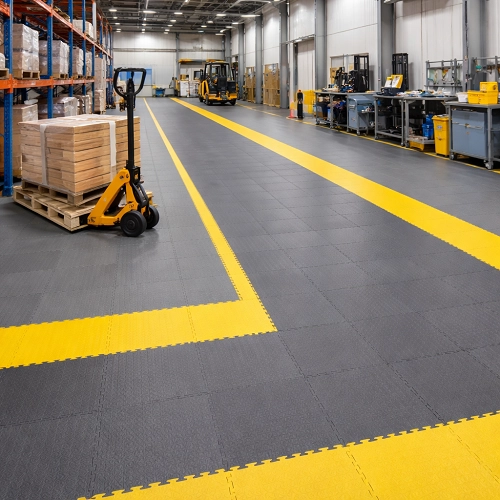
Industrial vinyl flooring tiles (IVFT) are a cornerstone of modern commercial and industrial flooring systems. Engineered to withstand intense wear and tear while offering design flexibility and long-term performance, these tiles are increasingly favored across warehouses, manufacturing plants, healthcare facilities, retail spaces, and more.
What Are Industrial Vinyl Flooring Tiles?
Industrial vinyl flooring tiles are resilient flooring products made primarily from polyvinyl chloride (PVC), combined with various additives and reinforcements to enhance durability and performance. Unlike residential vinyl flooring, which prioritizes aesthetics and comfort, industrial vinyl tiles are formulated for heavy-duty use, offering higher resistance to abrasion, impact, chemicals, and heavy loads.
Vinyl flooring tiles come in various formats: loose-lay tiles, glue-down tiles, interlocking tiles, and modular systems designed for specific subfloor conditions and performance requirements.
Composition and Technical Structure
At a basic level, industrial vinyl tiles are multi-layered composites engineered for strength and resilience. A typical industrial vinyl tile includes:
Wear Layer
- The topmost layer, typically measured in mils (1 mil = 0.001 inches).
- Made from clear PVC or polyurethane (PU) surface treatment.
- Provides resistance to abrasion, scuffing, staining, and chemical exposure.
- Industrial grades often range from 20 mil to 40 mil or more for high-traffic areas.
Print/Decor Layer
- Located beneath the wear layer.
- Carries the visual design — from solid colors and patterns to simulated stone or abstract motifs.
- Customization options can incorporate anti-slip textures or industrial markings.
Core Layer
- The structural backbone of the tile, typically a dense vinyl composite.
- Imparts dimensional stability and load-bearing capacity.
- May include fillers (e.g., limestone) to enhance rigidity.
Backing Layer
- The bottom layer that interfaces with adhesive or interlocking systems.
- Can be cushion-backed for acoustics or high-density for added strength.
- Some tiles include fiberglass or felt-reinforced backing to reduce expansion and contraction.
Optional Reinforcements
- Glass fiber mats to enhance dimensional stability.
- Mineral fillers to improve compressive strength.
- Antistatic additives for electrostatic discharge (ESD) control.
Performance Characteristics
Durability
Industrial vinyl tiles are engineered to withstand continuous foot traffic, heavy machinery, and frequent cleaning cycles. The wear layer is the primary determinant of long-term performance; thicker wear layers correlate with higher abrasion resistance and longer service life.
Chemical Resistance
PVC naturally resists many industrial chemicals, including mild acids, alkalis, oils, and solvents. This property makes vinyl tiles suitable for labs, pharmaceutical facilities, and manufacturing plants where chemical spills are common.
Impact and Load Resistance
The dense core structure disperses point loads from heavy equipment (e.g., forklifts, pallet jacks), minimizing surface deformation. Industrial grades are tested for static load limits, often measured in psi (pounds per square inch).
Slip Resistance
Surface textures and matte finishes offer traction even when wet. Slip resistance is typically quantified using the Coefficient of Friction (COF), with industrial spaces often aiming for values that meet OSHA and ADA safety standards.
Thermal and Dimensional Stability
Quality vinyl tiles resist shrinkage or expansion due to temperature or humidity changes, maintaining seamless joints and reducing the risk of buckling.
Acoustic Properties
Some industrial tiles incorporate cushion or foam backings to dampen noise — a valuable attribute in busy industrial zones or large open-plan facilities.
Specifications and Standards
Industrial vinyl flooring products are typically tested and certified according to industry standards:
- ASTM F1700/F1700M: Specifies requirements for solid vinyl floor tile.
- ASTM E648: Critical Radiant Flux test for fire resistance in flooring.
- ASTM D3389: Taber Abrasion test measuring wear resistance.
- ISO Standards (e.g., ISO 10581): Quality benchmarks for homogeneous vinyl tiles.
- Static Load Limit: Often specified by manufacturer, expressed in psi.
Understanding these standards helps facility managers and architects select products that meet regulatory and performance requirements.
Installation Methods
The success of an industrial vinyl flooring project depends heavily on proper installation. Common methods include:
1. Glue-Down Installation
- Most widely used for industrial environments.
- Tiles are adhered directly to the subfloor with suitable adhesive.
- Provides maximum stability and minimizes movement under load.
2. Loose-Lay Systems
- Tiles are designed to stay in place through weight and friction, without adhesive.
- Best for spaces where future removal or replacement may be needed.
- Requires highly flat and smooth subfloor.
3. Interlocking Tiles
- Edges are machined to lock together without adhesive.
- Often used in modular applications or where ease of replacement is critical.
4. Full-Spread Adhesive or Pressure-Sensitive Adhesive
- Full-spread adhesives create a continuous bond beneath the tile.
- Pressure-sensitive adhesives allow tiles to be repositionable before full set.
Subfloor Preparation
Subfloor quality is critical:
- Must be clean, dry, and level (typically within ±3/16" over 10 feet).
- Moisture testing (e.g., calcium chloride or relative humidity tests) ensures the slab is within permissible moisture limits.
- Concrete repairs and grinding may be necessary prior to installation.
- Primers and sealers can enhance adhesion and reduce outgassing.
Maintenance and Lifecycle Care
Proper maintenance extends the life of industrial vinyl flooring:
- Routine Cleaning: Dry dust mopping followed by damp mopping with pH-neutral cleaners.
- Spill Control: Promptly remove chemical or oil spills to prevent surface degradation.
- Protective Measures: Use mats near entrances and high-impact zones.
- Periodic Inspection: Check for edge lifting, seam separation, or wear layer thinning — address issues promptly to prevent larger damage.
With typical industrial wear layers, vinyl tiles can last 10–20 years or more, depending on traffic and care.
Applications Across Industries
Manufacturing and Warehousing
- Handles heavy traffic and equipment movement.
- Chemical resistance makes it ideal for facilities with routine spills.
Healthcare
- Hygienic and easy-to-sanitize surfaces.
- Can integrate antimicrobial additives.
Retail and Commercial
- Durable yet visually versatile for high-traffic showrooms and storefronts.
Laboratories and Cleanrooms
- Low particulate shedding and ESD versions available.
- Compatible with stringent cleanliness requirements.
Educational and Public Buildings
- Resilient surface that withstands daily heavy footfall.
Sustainability Considerations
Many manufacturers now offer:
- Phthalate-free formulations to reduce harmful plasticizers.
- Recyclable or recycled-content tiles to lower environmental impact.
- Low VOC emissions for better indoor air quality, often certified by programs such as FloorScore® or GREENGUARD.
Choosing the Right Industrial Vinyl Tile
When selecting a product, consider:
- Wear Layer Thickness: Higher mils = higher durability.
- Environment: Chemical exposure, moisture, temperature extremes.
- Traffic Load: Heavy-duty equipment vs. pedestrian traffic.
- Safety Needs: Slip resistance, ESD control.
- Aesthetic Requirements: While secondary to performance, color and pattern may matter in commercial spaces.
Industrial vinyl flooring tiles offer a versatile, durable, and cost-effective flooring solution tailored to the demands of commercial and industrial environments. Their engineered multi-layer construction delivers resilience against abrasion, impact, chemicals, and heavy traffic while accommodating a range of installation methods and aesthetic choices. With proper selection, installation, and maintenance, industrial vinyl tiles can provide long service life and reliable performance across diverse applications — from manufacturing floors to healthcare corridors and retail arenas.